Oceanir
  • Pricing
SalesStart free
Blog/Case Studies
Case Studies

How a Newsroom Verifies a Photo with Oceanir

A real image, run through Oceanir end to end. Every cue and confidence tier below is an actual result. This is the workflow a verification desk uses on deadline.

Oceanir Team·Jul 5, 2026·9 min read
How a Newsroom Verifies a Photo with Oceanir

A photo lands in your tip line. A private jet on a tarmac. A commercial airliner behind it. Dry grass, a flat horizon. The caption claims one airport. Your editor wants it in the next hour.

Is it real, and was it taken where they say?

Get it wrong and you have amplified a hoax. The verification tax on every visual story used to cost hours of manual OSINT work. Here is the same job in under two minutes, with an evidence chain you can publish.

The professional standards

Newsrooms and OSINT investigators have been verifying photos for over a decade. Oceanir automates the Location pillar. The rest (provenance, source, date, motivation) still require editorial judgment.

First Draft NewsFive Pillars

Provenance, Source, Date, Location, Motivation. Provenance matters most.

BellingcatEDRM Workflow

Identify, collect, preserve, verify, analyze, review, present.

ReutersVisual Verification

24/7 monitoring, OSINT geolocation, origin tracing, rights clearance.

Associated PressAP Verify (2025)

AI-assisted dashboard for geolocation, landmark detection, reverse search.

BBCEditorial Guidelines: UGC

Three tiers: verified, believed genuine, unverified.

Step 1. The image, cold

No caption. No metadata. No EXIF. Oceanir never uses it. The location has to come from the picture itself, the same standard a skeptical reader would hold you to.

Instagram, Facebook, X, Telegram. They all strip EXIF on upload. If your verification depends on embedded GPS, it fails on the exact images that land in a tip line. Oceanir works from visual content alone.

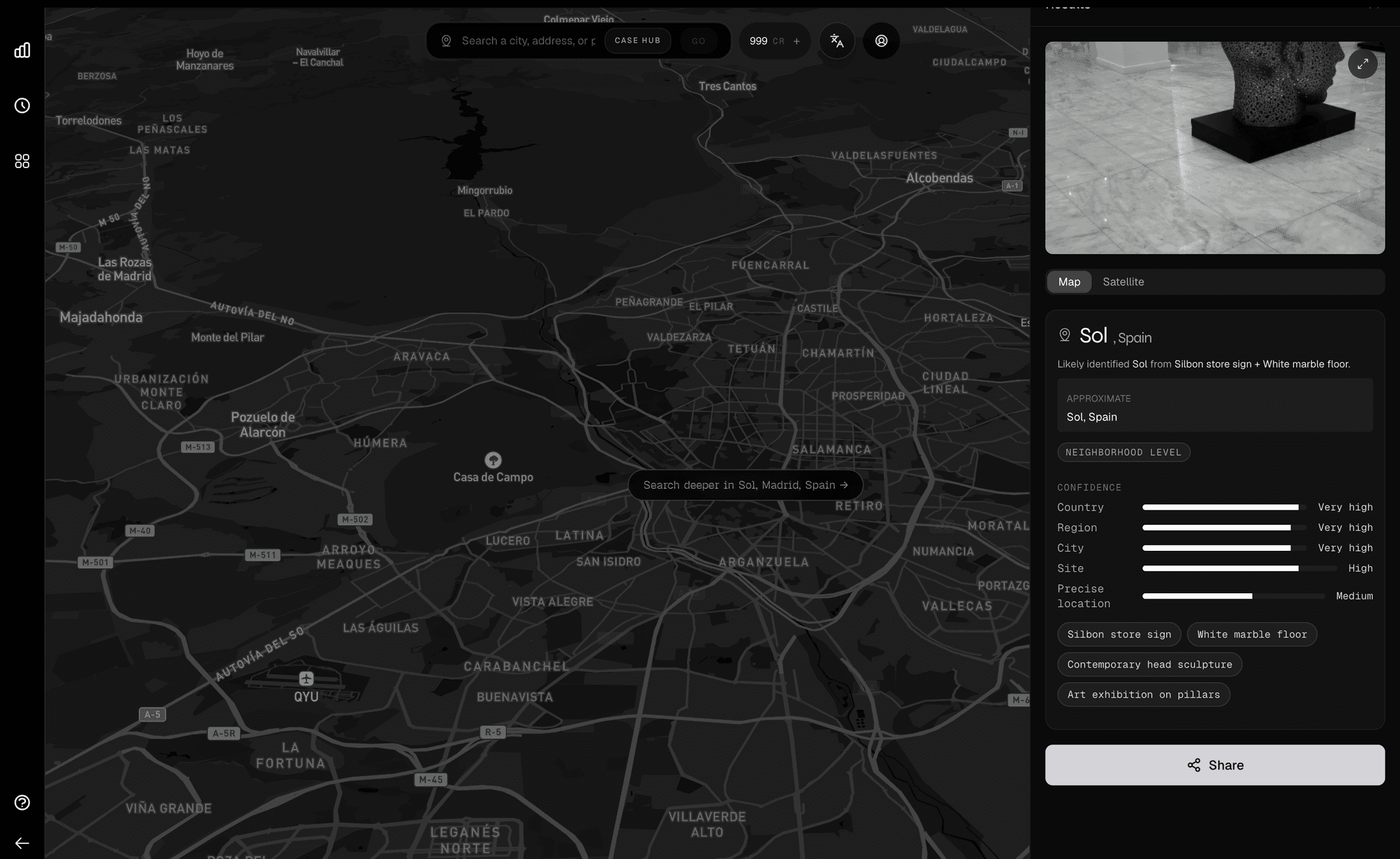
Source image example

Source image

No EXIF. No metadata. No caption. Just pixels from a tip line screenshot.

Satellite cross-check example

Satellite cross-check

Oceanir pulls satellite and 3D to match against the source cues. Apron, fencing, scrub line.

Step 2. What the image tells you

Every claim is tied to a cue you can point at. Five independent evidence categories converge on the same place. The professional standard requires three. Oceanir gives you five.

Visual cue
Category
What it rules in or out
N-registration N443SC
Text / Registry
U.S.-registered aircraft. Country locked.
American Airlines tail
Operations
Commercial airport with scheduled service.
Scrub oak and pitch pine
Biome
Northeastern coastal U.S. Not California. Not Texas.
Chain-link perimeter fence
Infrastructure
Small coastal field, summer season.
Ramp shuttle bus
Operations
Seasonal airport overflowing its lot.

Every cue is falsifiable. A reader can check the tail number. A source can dispute the vegetation. That is what makes it verification.

Evidence Funnel

Five cues narrowing to one location

5

Visual cues extracted

Tail number, livery, vegetation, fencing, shuttle

4

Country + region locked

N-registration, scrub oak biome

3

City + site confirmed

Coastal field, commercial service, KACK

1

Precise location

Apron perimeter, high confidence

Step 3. From cues to a place

The cues narrow the answer one confidence tier at a time. A black-box pin on a map is not enough. The desk needs the reasoning chain.

Confidence Tiers

How the cues narrow the answer

CountryUnited States
Very High

(N-registration)

RegionU.S. Northeast
Very High

(scrub oak / pitch pine)

CityNantucket
Very High

(coastal field + summer)

SiteNantucket Memorial Airport
Very High

(KACK)

Preciseapron / perimeter
High

(high, not certain)

Result: Nantucket Memorial Airport (KACK), Nantucket, MA.

Precise location is High, not Very High. A tool that claims 100% on everything is lying to you. The value is knowing exactly how far the evidence carries, and where it stops.

How tiers map to editorial practice

Oceanir
Editorial equivalent
What it means
Very High
Verified (BBC) / Green (First Draft)
Safe to publish with standard attribution
High
Believed genuine (BBC) / Amber
Publish with a caveat. Note what is unconfirmed.
Medium
Lead, not confirmation
Investigate further before publication.
Low
Insufficient evidence
Do not publish. Use as a search lead only.

Step 4. The check

Satellite and 3D of Nantucket Memorial Airport line up against the source cues. Apron layout, perimeter fencing, scrub line, seasonal ramp operation. This is the part that goes in the story. A documented chain from a visible detail to a place a reader can retrace.

Street View is not shown. Airport tarmacs have no interior coverage. Satellite and 3D are the right check for restricted-access sites. A Bellingcat investigator would make the same call.

Step 5. Provenance

Location is half the job. The other half is provenance. Is this the original image, or has it been recycled and miscaptioned?

If the caption claims yesterday but the earliest indexed appearance is 19 months old, on a regional news site with a different caption, that is an immediate red flag. Reuters used this technique to debunk a "Maui wildfire" video that was actually a 2022 mulch fire in Cleveland, Ohio. AFP used it to trace "Iranian nuclear site" footage to tourist attractions in Nicaragua and Saudi Arabia.

This turns a one-time verification into an ongoing intelligence feed. If the photo resurfaces with a new caption, the desk knows within hours.

Verification timeline (90 seconds)

Time
Action
T+00s
Image arrives. No caption, no metadata, no EXIF. Just pixels from a tip line.
T+12s
Oceanir extracts visual cues: tail number, airline livery, vegetation, fencing, ramp operations.
T+28s
Cues narrow to ranked location candidates with tiered confidence. Country through site.
T+55s
Satellite and 3D cross-check against the top candidate. Apron, fencing, scrub line confirmed.
T+90s
Analyst receives a documented evidence chain ready for editorial review and publication.

Time to defensible location

Manual OSINT vs Oceanir (log scale)

Time reduction

99.9%

1s1 min1 hr4 hrsmanual OSINT4hreverse search1800sOceanir D255sOceanir D390s

Human vs Oceanir

The same verification job, side by side

Human analyst
Time
Oceanir
Time
1

Save image, check EXIF. Stripped? Move on.

2 min

Image received. No EXIF needed.

0s
2

Google Lens, Yandex, TinEye reverse search. No hits.

10 min

Visual cues extracted automatically.

12s
3

Read the image. Note tail number, vegetation, fences.

15 min

Five cues identified and categorized.

16s
4

Search tail number on FAA registry. Confirm U.S.

8 min

Country locked. N-registration.

18s
5

Cross-reference vegetation with ecology maps.

30 min

Region locked. Scrub oak, pitch pine biome.

22s
6

Search coastal airports with commercial service.

45 min

City and site confirmed. KACK.

28s
7

Open Google Earth. Walk satellite imagery by hand.

90 min

Satellite and 3D cross-check automated.

55s
8

Document findings. Write up evidence chain.

30 min

Evidence chain generated automatically.

90s
Total
~3h 40m
Total
90s

Measured outcomes

Manual workflow

4 to 6 hrs

Senior analyst walking Street View, cross-referencing satellite imagery by hand.

With Oceanir

under 90 sec

Same evidence chain, same defensible standard, delivered to the desk.

Independent anchors

5

Exceeds the three-anchor threshold for publication-grade verification.

Verification is showing your work. That is the difference between a tool that geolocates and a tool a newsroom can stand behind.

Real cases where geolocation caught a hoax

Oceanir automates the core of this work. The editorial judgment remains human.

Reuters

Social posts claimed a video of flames showed the 2023 Maui fires.

Outcome: Miscaptioned. The clip showed a 2022 mulch fire in Cleveland, Ohio.

Method: Geolocated visible signs using Google Street View. Traced a ViralHog YouTube upload.

AFP

A viral compilation was falsely described as Iranian nuclear sites.

Outcome: False context. Clips were from tourist sites in Nicaragua and Saudi Arabia.

Method: Reverse image search of keyframes, source-account tracing, Google Maps comparison.

Bellingcat

A far-right fight night event was posted on Telegram.

Outcome: Confirmed the venue as Fuhrmann Hall, Heritage Park Events Center, Muenster, Texas.

Method: Matched a US flag, MVFD table marking, ceiling, windows, and doors against venue results.

Bellingcat

A video allegedly showed a Buk launcher in Snizhne after MH17.

Outcome: Confirmed the route and vantage point, placing the launcher 10 to 15 km from the crash site.

Method: Matched road geometry, trees, junctions, and a red-roofed house against Google Earth.

Sources

  • First Draft News. Verifying Online Information. The five pillars.
  • Bellingcat. Beginner's Guide to Social Media Verification and J&A Manual.
  • Reuters. Verification Services. UGC with rights clearance.
  • Associated Press. AP Verify (2025).
  • BBC. Editorial Guidelines: UGC. Verified, believed genuine, unverified.
  • EBU Spotlight. Investigative Geolocation and Advanced GEOINT.

Run your own image

Upload an image and get a defensible location with a documented evidence chain in minutes.

Launch Demo →Talk to us

Related posts

View all
Introducing Desktop, the world's first visual intelligence workspace
product

Introducing Desktop, the world's first visual intelligence workspace

The value was never just the prediction. It is the workflow around the prediction. Oceanir Desktop is where that workflow finally has a home.

The Complete Image Geolocation Workflow: From Metadata to Map Verification
product

The Complete Image Geolocation Workflow: From Metadata to Map Verification

The full chain analysts run to geolocate an image: EXIF check, visual anchors, reverse image search, AI estimation, and map verification, ending in a documented confidence trail.

Orca, to your favorite cities.
product

Orca, to your favorite cities.

102-city coverage, more city-native reads, and sharper confidence in the places people actually asked us for.

01platform
  • Pricing
  • Geoestimation
  • How It Works
02resources
  • Blog
  • Documentation
  • Contact
03company
  • About Us
  • Security
04legal
  • Terms
  • Privacy
  • Product Boundaries
  • SaaS Agreement
  • Cookies

Notes from the verification desk. What we're learning about reading places from pixels. Occasional, no noise.

Try it on one image

Upload a photo. Watch it come back as a place.

Run a free analysis →Talk to us →
Summarize with AI
oceanir
© 2026 Oceanir, Inc. All rights reserved.
PrivacyTerms